Jeremy Harmer
Videos & Podcasts
Videos & Podcasts

A Humanistic Approach to Course Materials. Jeremy Harmer, HLT Digital 2023.
How Humanistic Approaches have Influenced My Work in Teacher Training. Jeremy Harmer, HLT Digital 2023.
What Humanism Means to Me. Jeremy Harmer, HLT Digital 2023.
The New School. 2013. Communicative Language Teaching: Jeremy Harmer and Scott Thornbury.
ISTEK. 2013. Does Correction Work? It Depends Who You Ask
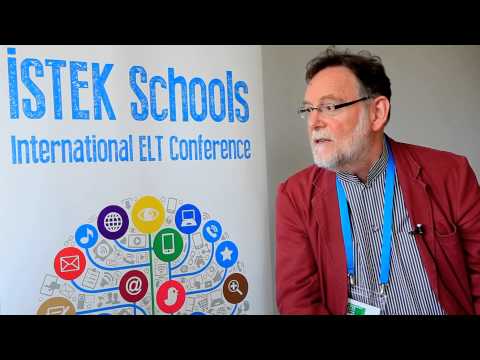
ISTEK. 2013. Interview with Jeremy Harmer - ISTEK ELT 2013.
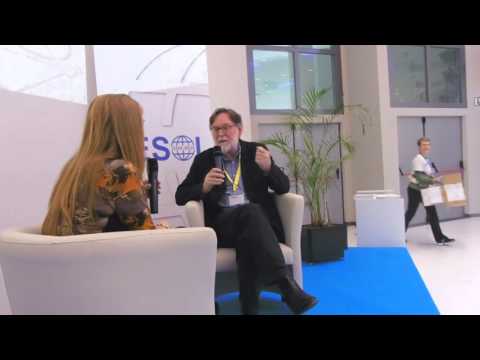
TESOL-Spain. 2015. TESOL-SPAIN 39th Annual Convention interview with plenary speaker Jeremy Harmer.
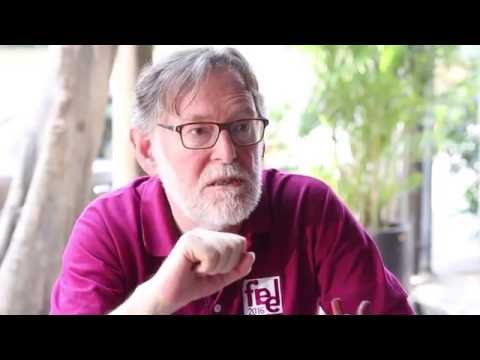
Helbling English. 2016. Interview with Jeremy Harmer - Helbling Day Mexico 2016.
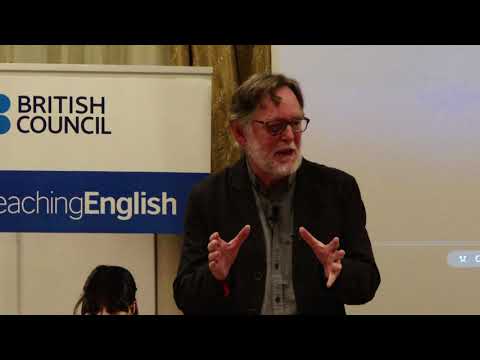
BC Armenia. 2017. Through a Glass Darkly: Does ELT have a Future?
BC Armenia. 2017. I Don’t Teach Answers.
BC Armenia. 2017. Telling and Retelling: The Magic of Stories in ELT.
BC Armenia. 2017. Sacred Gift or Faithful Servant? Focus on Creativity in the Classroom.

BC Armenia. 2017. All together now? Why Classes are Mixed Ability and What we Can do About it.

TransformELT. 2020. The Future of English Language Teaching: 1. Jeremy Harmer.

We’re All in this Together. 2021. Interview with Jeremy Harmer on We're All in This Together.
CTD - Coaching, Training and Development. 2021. CTD Interviews Jeremy Harmer - Author.
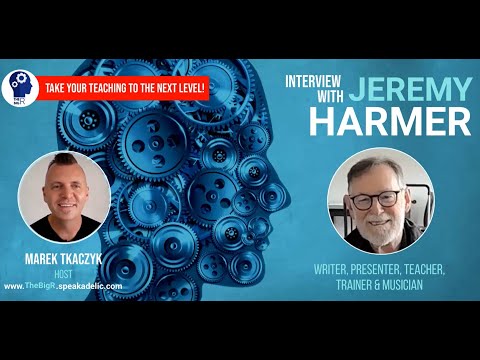
THE BIG R - Take your Teaching to the Next Level. 2022. Interview with Jeremy Harmer.

English with Cambridge. 2022. On the Sofa with Jeremy Harmer - Cambridge Live.
2020. TransformELT. The Future of English Language Teaching: 1. Jeremy Harmer
2021. We’re All in this Together. Interview with Jeremy Harmer on We're All in This Together
2017. James Green. Jeremy Harmer Talking About Student Motivation
2018. Emma Pratt. The Power of Being Present in Language Learning and Teaching - An Interview with Jeremy Harmer
Jack Scholes from New Routes. Interview with Jeremy Harmer
Podcasts
2017. Ross Thorburn from TEFL Training Institute Podcast. The Complexity of Correction (with Jeremy Harmer). (source)
2019. Teacher Talk. Talking about Music and Language Learning - with Jeremy Harmer. (source)
2020. TEFL Training Institute Podcast. The Who, What, How, When and Why of Error Correction. (source)
2023. TEFL Training Institute Podcast. Deliberate Learning (with Jeremy Harmer). (source)
2023. pFITE: The Podcast. Anna Pilar and Jeremy Harmer. (source)
2023. My Hinterland. My Hinterland: What we do when we are not doing what we do. (source)
Jeremy Harmer
Recommended books
Notional Syllabuses
David Wilkins
The first book to make me understand the lexical component of language and how we might reflect that in our work.
Caring and Sharing in the Foreign Language Classroom
Gertrude Moskowitz
Easy to make fun of, but profound in her emphasis on making learning a positive experience.
Musical Openings
David Cranmer, Clement Laroy
Maybe a bit too ‘music specialist’ but an ode to unleashing creative potential.
Guitar Zero: The Science of Becoming Musical at Any Age
Gary Marcus
About learning the guitar, yes, but it’s also about cognition and a scientific account of why learning takes place in the brain.
Teaching Unplugged
Scott Thornbury, Luke Meddings
A controversial (?) ‘reach-out’ for a genuinely student-centred way of teaching.
Place in HLT
“Even before I got to know him personally, Jeremy was a key influence on my thinking about teaching and learning – primarily due to his role in popularising communicative language teaching in the 1980s. Through his books like The Practice of English Teaching (the first edition of which was published in 1983), he introduced a generation of teachers, not just to CLT, but to other – equally innovative – approaches, including humanistic language teaching. Jeremy was never a ‘signed-up’ humanistic practitioner in any doctrinaire sense, but re-reading his take on humanism in the 1991 edition of the book, I am again in awe of his capacity to capture the essence of the movement in a fair and balanced way, without any of the cheap shots (‘touchy-feeliness’!) which characterised my own, less measured, outbursts at the time (blush!). In an email exchange a few years back, in preparation for a talk I was giving, I asked him if he felt he had ‘an agenda’ when he wrote his methodology texts. His answer: ‘Rather boringly, I try not to be seduced by any particular position and my absolute certainties about what we do tend to fluctuate (although core beliefs remain the same I think).’ I would hazard that those core beliefs share a lot with humanism, because, au fond, Jeremy is a humanist, in the small-h sense, and everything he says and writes about teaching is infused with a genuine love of people, and of language learning as a form of self-realisation.”
